Compost curing process
Curing is the secondary stage of composting that comes after the active, high-heat decomposition phase. For commercial producers, it is a controlled production step rather than passive storage. It determines whether a batch passes stability and maturity testing and qualifies for certification. Managing it well protects both product quality and market readiness.
Key Takeaways
- Curing is an active, monitored production stage, not idle storage time.
- Target a C:N ratio of 20:1 or lower and moisture between 45–60% before and during curing.
- Two properties are verified separately: stability (oxygen consumption) and maturity (plant safety).
- Certification (e.g., USCC’s STA program, EU) requires documented testing, not visual inspection alone.
- Facility design must allocate dedicated curing space, separate from active composting.
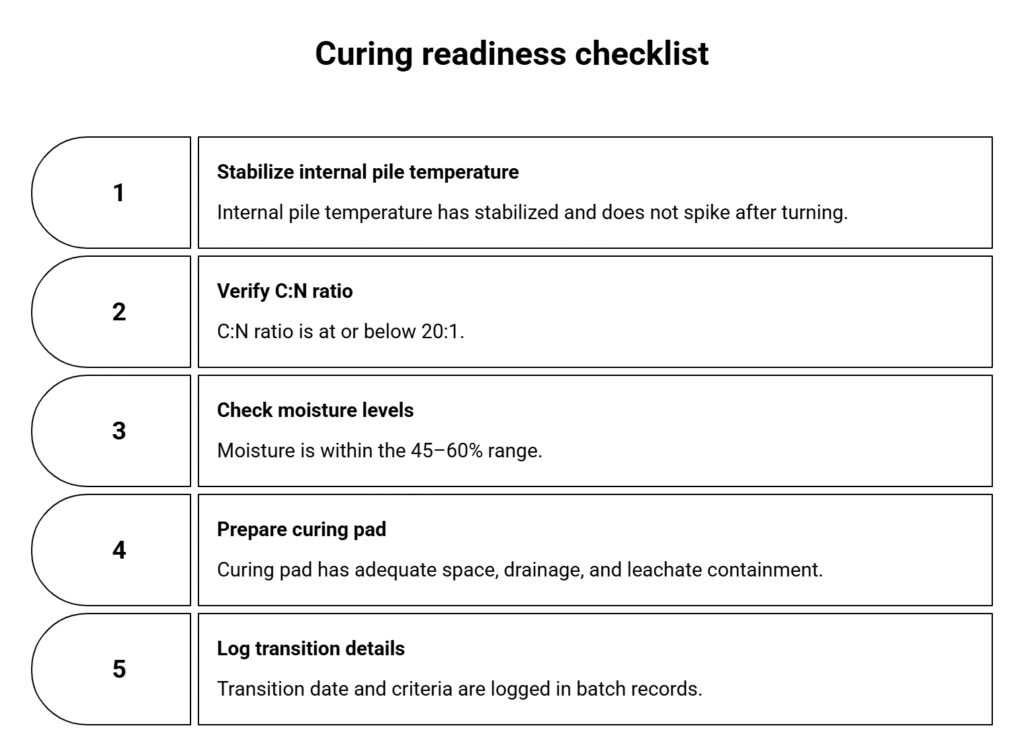
- Curing readiness checklist
What happens during the stabilization phase?
After active composting, microbial activity slows but continues. This maturation period involves two related but distinct sets of changes.
Chemical changes:
Oxygen demand drops as readily decomposable material is used up. Some organic acids and ammonia are still left over at this point. These are plant-damaging substances that can injure roots if the compost is applied too early. During curing, they keep breaking down. At the same time, stable humic substances continue forming. These are long-chain organic molecules that give finished compost its dark color and soil-building value.
Biological changes:
The pile cools down, and a new mix of life moves in. The heat-loving organisms that dominated the hot phase start to die back. In their place, a broader community shows up bacteria, fungi, and other decomposers that prefer cooler temperatures. This shift rebuilds the microbial diversity in the pile, and that diversity is part of what gives cured compost its disease-suppressive properties.
QA teams track two separate properties during this secondary decomposition stage. The first is stability: how much easily degradable matter is left. Teams measure this through respirometry, which tracks oxygen consumption or CO₂ output as a stand-in for microbial activity.
The second is maturity: whether the compost is free of plant-damaging compounds. Teams measure this through a bioassay, such as the Solvita test or a seed germination trial. No single test captures both properties. That’s why certification programs require a combination of tests, not just one.
What are the risks of shipping under-cured compost?
Shipping under-cured compost creates measurable risk. Plant-damaging compounds can trigger phytotoxicity complaints and crop damage claims. If decomposition is still active when compost reaches the field, it causes nitrogen drawdown. Microbes are still hungry for nitrogen at this stage.
They compete with the crop for the same nitrogen the plant needs, and the plant loses out. Shipping batches before they pass stability testing carries its own risk, too. It can put a facility’s certification status on the line. Poorly managed curing piles are also a common source of odor and vector complaints at the facility itself.
Properly cured compost tells a different story. With good documentation, it passes third-party testing consistently. It also meets the specs buyers increasingly ask for.
Facility design requirements
USDA NRCS Composting Facility standards (Code 317) set a clear rule here. Curing space must be physically separate from active composting. It’s a design requirement. Facilities should plan curing pad capacity before they scale up production. Site plans also need to account for leachate collection and containment on the curing pad. That standard matches the pollution-prevention rules already applied to the active composting area.
Environmental control parameters
Curing piles should be smaller than active-phase windrows. A smaller pile keeps air moving through it naturally. Operators need to hold moisture between 45–60% for the whole curing period. Turning frequency should drop as oxygen demand falls. Once a pile is heavily stabilized, it may only need occasional turning or none.
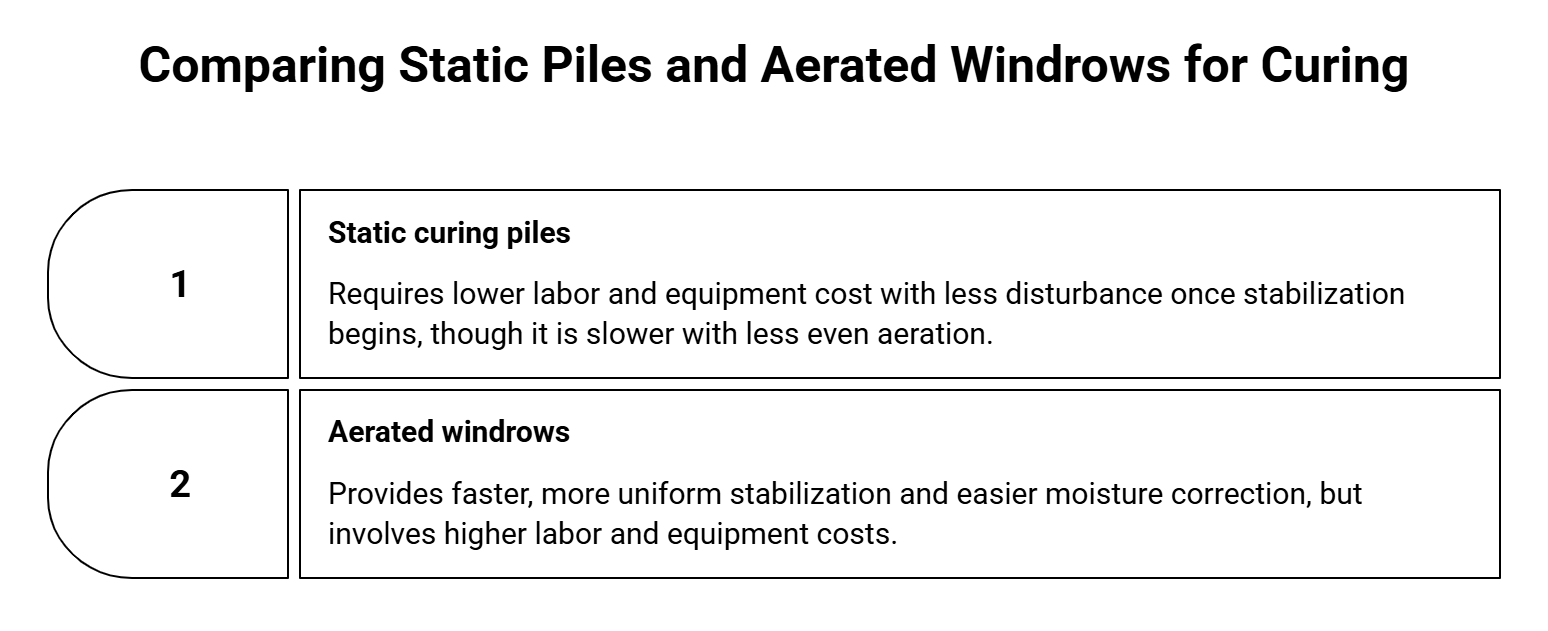
Static piles vs. aerated windrows for curing:
Determining completion
Move material from active composting to curing once pile temperature stabilizes after turning and the C:N ratio reaches 20:1 or lower. There is no single mandated curing duration that applies across all feedstocks; requirements vary by state program and end-use classification.
Some states tie curing completeness to Reduction in Organic Matter (ROM), a measure of how much organic matter has broken down relative to the starting material. Texas, for example, uses approximately 60% ROM as a boundary between “mature” and “cured” classifications.
BioCycle research cautions that ROM thresholds have a scientific limitation: compost samples with very different total organic matter content can satisfy the same ROM percentage while behaving quite differently in the field. ROM should therefore be used alongside stability and maturity testing, not as a stand-alone completion metric.
Curing readiness checklist
How Do I certify my compost for the market?
The US Composting Council runs the main third-party certification program in the US: the Seal of Testing Assurance (STA). It’s built on TMECC. Test Methods for the Examination of Compost and Composting. Think of TMECC as the industry’s standard testing playbook. Facilities enrolled in STA test on a regular schedule. They check stability through respirometry and maturity through bioassay. They also test nutrients, pH, soluble salts, particle size, pathogens, and trace metals. Every result gets shared with buyers on a standardized Compost Technical Data Sheet.
Facilities processing biosolids must additionally document compliance with Process to Further Reduce Pathogens (PFRP) requirements the federal standard for pathogen Removal under 40 CFR Part 503. Internationally, the UK’s PAS 100 specification relies on a comparable respirometric protocol (ORG0020).
A certified batch comes with documented test results. A buyer can check those results against a spec and trust them. A non-certified batch doesn’t have that backup. It relies on the producer’s word alone. That gap matters. It can shut a producer out of specification-driven contracts, like DOT or municipal projects.
EU Certification: Regulation, not a single seal
Producers marketing compost in the EU work with a different, more fragmented structure than the single-seal US model, built around three overlapping layers.
The EU Fertilising Products Regulation (FPR, Regulation 2019/1009).
This is the harmonized, EU-wide framework governing CE-marked fertilizing products. Compost belongs to Component Material Category 3 (CMC 3) in Annex II. This category outlines the criteria a compost must meet to be considered a product instead of waste. These criteria include stability, particle size, and limits on contaminants. A CE-marked product under the FPR can move freely across EU member states without needing separate national approval. This is important for producers who sell in more than one country.
The European Compost Network Quality Assurance Scheme (ECN-QAS).
ECN-QAS isn’t a certifying body itself. It’s a harmonization framework that sits above national programs. Here’s how it works: national quality assurance organizations get audited against EN 17065, the standard for certification bodies. Once an organization passes that audit, it can issue the ECN-QAS label to individual composting plants. Several countries already take part. Germany’s BGK is one. So are Austria’s KBVÖ, Belgium’s Vlaco, and Italy’s CIC.
National standards underneath the EU layer.
Individual countries still run their own systems, and producers typically need to meet the national standard in addition to (or as the practical route into) EU-level compliance:
How do I resolve odor or testing failures?
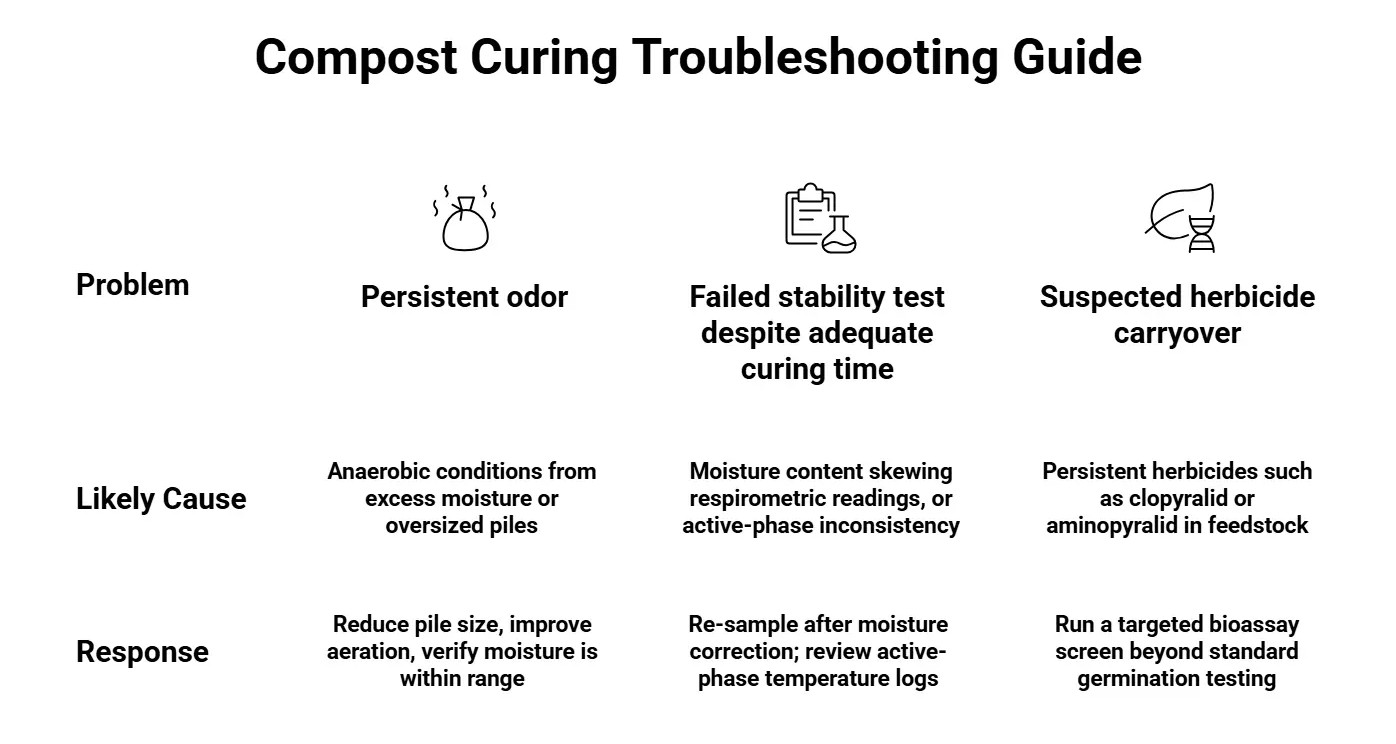
Documentation
Batch records need a few key things. Start with active-phase time-temperature logs. Add the date and criteria used for the transition to the maturation period. Include moisture and turning logs. Finish with stability and maturity test results. Together, this is the record set that lets you defend product quality to a customer or certifying body.
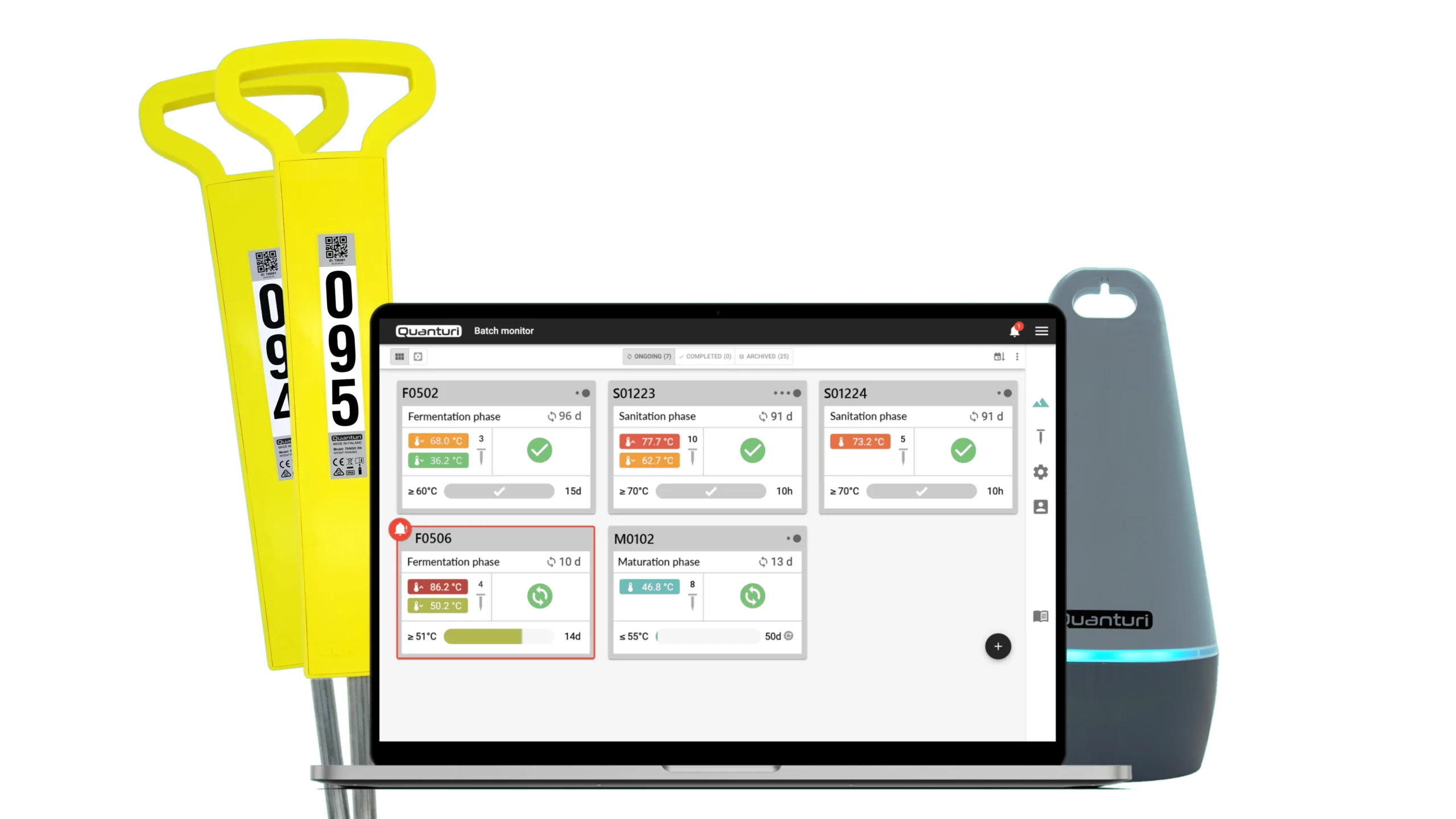
How does the Periskop compost monitoring system help in curing?
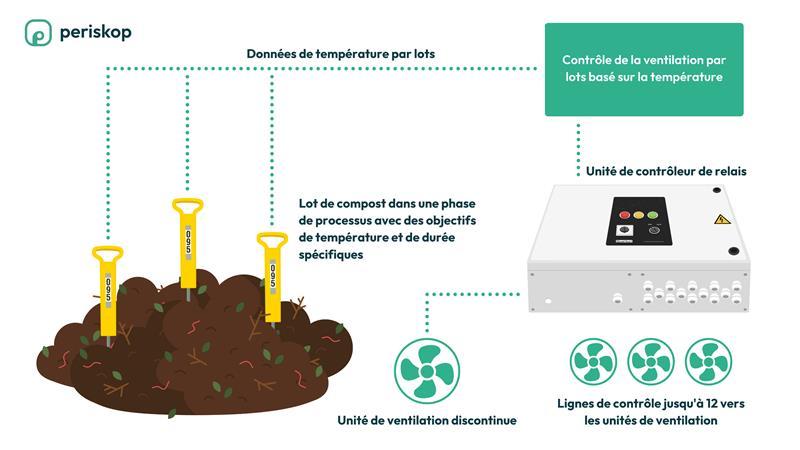
With the Periskop compost monitoring system, you can create a separate batch for each stage of the composting process. At every stage, you can monitor temperature data from the dashboard. Temperature is tracked automatically through both phases. Every reading gets logged, building a complete temperature history. That history can be downloaded as a report. It’s ready to support certification, compliance, and process documentation whenever you need it.
Resources
- US Composting Council, Seal of Testing Assurance (STA) Program
- US Composting Council / Compost Foundation, Test Methods for the Examination of Compost and Composting (TMECC)
- USDA NRCS, Conservation Practice Standard: Composting Facility (Code 317)
- EPA, Types of Composting and Understanding the Process
- BioCycle, “Characterizing Compost Completeness” — Reduction in Organic Matter (ROM) as an endpoint metric
- BioCycle, “Reducing Compost Stability Test Variability” — UK ORG0020 / PAS 100 respirometry protocol
- 40 CFR Part 503, Appendix B — Process to Further Reduce Pathogens (PFRP) requirements
- Humic substances — background reading