Nitrogen in compost: How It forms, transforms, and benefits your soil.
Compost works like a savings account that pays interest. Chemical nitrogen works more like spending cash fast. When farmers add compost, they can expect 10% to 20% of its nitrogen to become available to plants in the first year. After that, it keeps giving smaller amounts, about 5% to 10% each year “The Bug Whisperer,” by Kristin Ohlson. That’s because the soil stays active. It keeps breaking down organic matter and releasing nutrients over time. Tiny microbes in the soil also eat each other in a constant cycle, and this releases even more nutrients plants can use. Understanding the role of nitrogen in compost is important for composters as it has a higher market value.
Composting helps to return nitrogen to the soil. Its presence is important for plant growth. Returning nitrogen to soil requires a controlled composting process, and it takes time and resources. During the composting process, different reactions happen in the composting material.
Formation of nitrogen in compost
In compost, nitrogen is formed from ammonia and ammonium NH4+. However, ammonia is a gas and comes as a by-product from the breakdown of organic material. Ammonium NH4+ is a positively charged ion and forms when ammonia gas reacts with water H2O and releases H+ ions,. All this happened under acidic conditions. Temperature plays a crucial role in forming NH4+ a more stable form of nitrogen. If not managed properly, it can produce other chemicals which can generate compost odors like sulphur, etc.
High nitrogen materials for compost
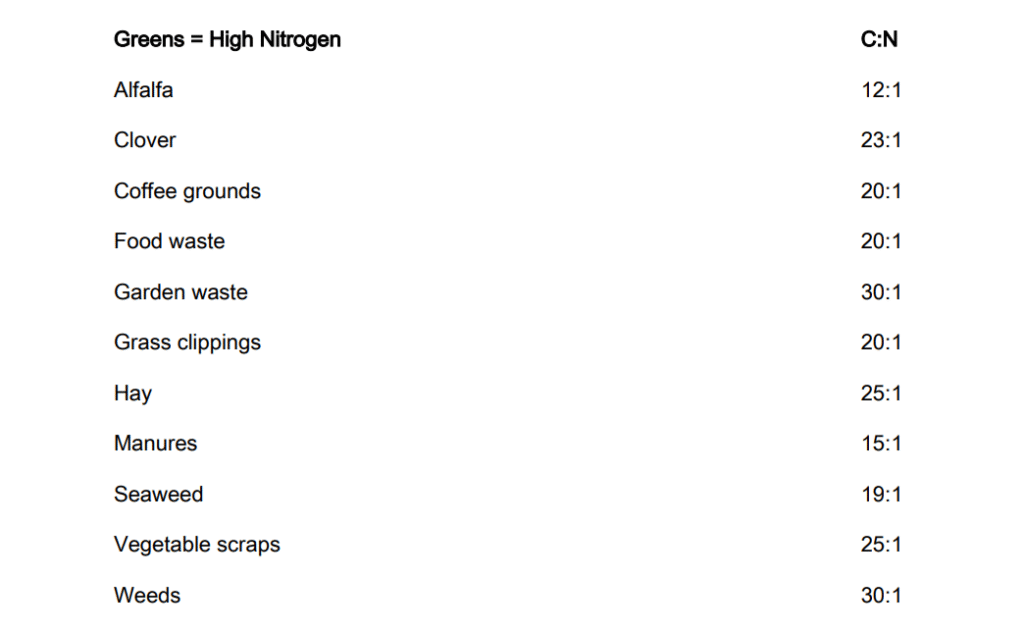
Image Source:https://www.gerrygillespie.net/uploads/4/5/6/5/45656863/carbon_and_nitrogen_ratios.pdf
Nitrate and Nitrite in Compost
Nitrate (NO₃⁻) and nitrite (NO₂⁻) are two important oxidized forms of nitrogen found in compost. Unlike ammonia and ammonium, nitrate and nitrite are produced during the later stages of composting, particularly under aerobic or oxygen-rich conditions.
Compost nitrification process
Their formation follows a clear sequence. Nitrification is the biological oxidation of ammonia, first to nitrite and then onward to nitrate, with nitrite serving as the key intermediate product in this two-step process. In other words, nitrite does not accumulate as an end product. It is a stepping stone on the way to nitrate.

Role of nitrifying bacteria in nitrification
This conversion is carried out in two steps by two distinct groups of microorganisms: ammonia-oxidizing bacteria or archaea (AOB/AOA), which handle the first step, and nitrite-oxidizing bacteria (NOB), which complete the transformation to nitrate.
The conversion of ammonia to nitrite is typically the rate-limiting step of the entire nitrification process meaning the speed of this first stage determines how efficiently your compost nitrogen becomes plant-ready.
Conditions requirement for nitrification process
To support nitrification in your compost pile, oxygen levels, moisture, temperature, and pH all play a role. Temperature between 43-71°C (110-160 °F) can increase microbial activity and supports nitrogen conversion. Adequate aeration is required for aerobic decomposition and supporting the activity of nitrifying bacteria, while proper moisture typically around 40–60% facilitates efficient nitrogen conversion.
Lower carbon-to-nitrogen ratios (more nitrogen-rich material) leave extra ammonium in the compost that nitrifying bacteria can convert into nitrate. Higher carbon-to-nitrogen ratios (more carbon-rich material) cause microbes to use up most of the ammonium for their own growth, leaving little for nitrification to occur.
What’s the ideal balance between carbon and nitrogen in compost?
A C:N ratio around 25-30:1 strikes the right balance, supporting good composting while still leaving enough ammonium for nitrification to happen later in the process.
How to tell if a compost pile needs more nitrogen?
You should be able to stick your hand near the center and feel real warmth within a few days. If it’s staying cool and the material still looks pretty much like it did when you added it, that’s usually a nitrogen problem.
What are the signs of too much nitrogen in a pile?
Your nose will tell you first. If the windrow smells like rotten eggs or ammonia, you have got too much nitrogen relative to carbon. The pile also tends to get slimy and compact instead of light and crumbly.
What’s the difference between nitrogen and carbon in compost?
Nitrogen fuels microbial growth. It’s basically protein for the microbes doing the decomposing. Carbon is their energy source, like a slow-burning fuel that keeps them going. You need both in the right balance, or the process stalls out.
References:
- Rafaela Cáceres, Krystyna Malińska, Oriol Marfà, Nitrification within composting: A review, Waste Management, Volume 72, 2018, Pages 119-137, ISSN 0956-053X, https://doi.org/10.1016/j.wasman.2017.10.049.
- https://craftsmanship.net/sidebar/compost-and-nitrogen-heroic-partners-or-sneaky-collaborators-in-pollution/
- https://craftsmanship.net/the-bug-whisperer/
- https://www.gerrygillespie.net/uploads/4/5/6/5/45656863/carbon_and_nitrogen_ratios.pdf