PAS 100 Temperature Monitoring Requirements: How to Achieve Compost Sanitization Compliance
For composting operations working toward PAS 100 compliance, temperature monitoring is a critical compliance challenge. It is the primary evidence base for your HACCP (Hazard Analysis and Critical Control Points) Critical Control Point (CCP) at sanitization, which means if your monitoring falls short, the entire sanitization step is invalidated.
The good news: once you understand exactly what PAS 100 requires, it is entirely manageable. This guide clearly explains the PAS 100 temperature requirements, outlining the key details and how the Periskop System can help you achieve sanitization compliance.
What is Publicly Available Specification 100 (PAS 100)?
The PAS 100 Mark is specific to United Kingdom. It is the nationally recognized industry standard and Publicly Available Specification (PAS), developed by the British Standards Institution (BSI), for the production of high-quality compost. Compost processing and production depend on strict compliance regulations around the globe. It’s always advisable to consult concerned authorities in your local region.
Key Takeaways
Before diving into the full detail, here is a summary of the most critical compliance points in sanitization:
- The recommended sanitization parameters are 65°C for 7 continuous days at a minimum moisture of 51% mass/mass.
- Probe placement rules differ significantly between system types particularly between turned windrows (core zone only) and uninsulated aerated static piles (all three zones).
- Calibration records must include a full record of key data and evaluation, not just a certificate and must be retained as Quality Management System (QMS) records.
What Are the Recommended Sanitization Parameters?
PAS 100 identifies the conditions under which most human, animal, and plant pathogens are eradicated including Plasmodiophora brassicae, Fusarium oxysporum f.sp. lycopersici, and Fusarium oxysporum f.sp. radicis-lycopersici:
- Minimum temperature: 65°C
- Continuous duration: 7 days
- Minimum moisture: 51% mass/mass
- Turning/mixing: as needed to expose the entire batch to these conditions
These are recommended parameters to inform your Critical Limit (CL) setting, not mandated CLs themselves. Operators are responsible for setting the actual CLs in their HACCP plan, based on input materials, process management, and intended compost uses.
Setting CLs below these values carries significant validation and regulatory risk. Where processes involve Animal By-Products (ABPs), materials of animal origin subject to specific regulatory controls, the competent authority’s approval specifies binding requirements that override everything else.
How Often Must I Monitor Temperatures for My Specific System?
Monitoring frequency requirements vary significantly depending on which composting system type is in operation. This is where composters most often encounter difficulties during audits.
The table below summarises the monitoring frequency for each system type and phase:
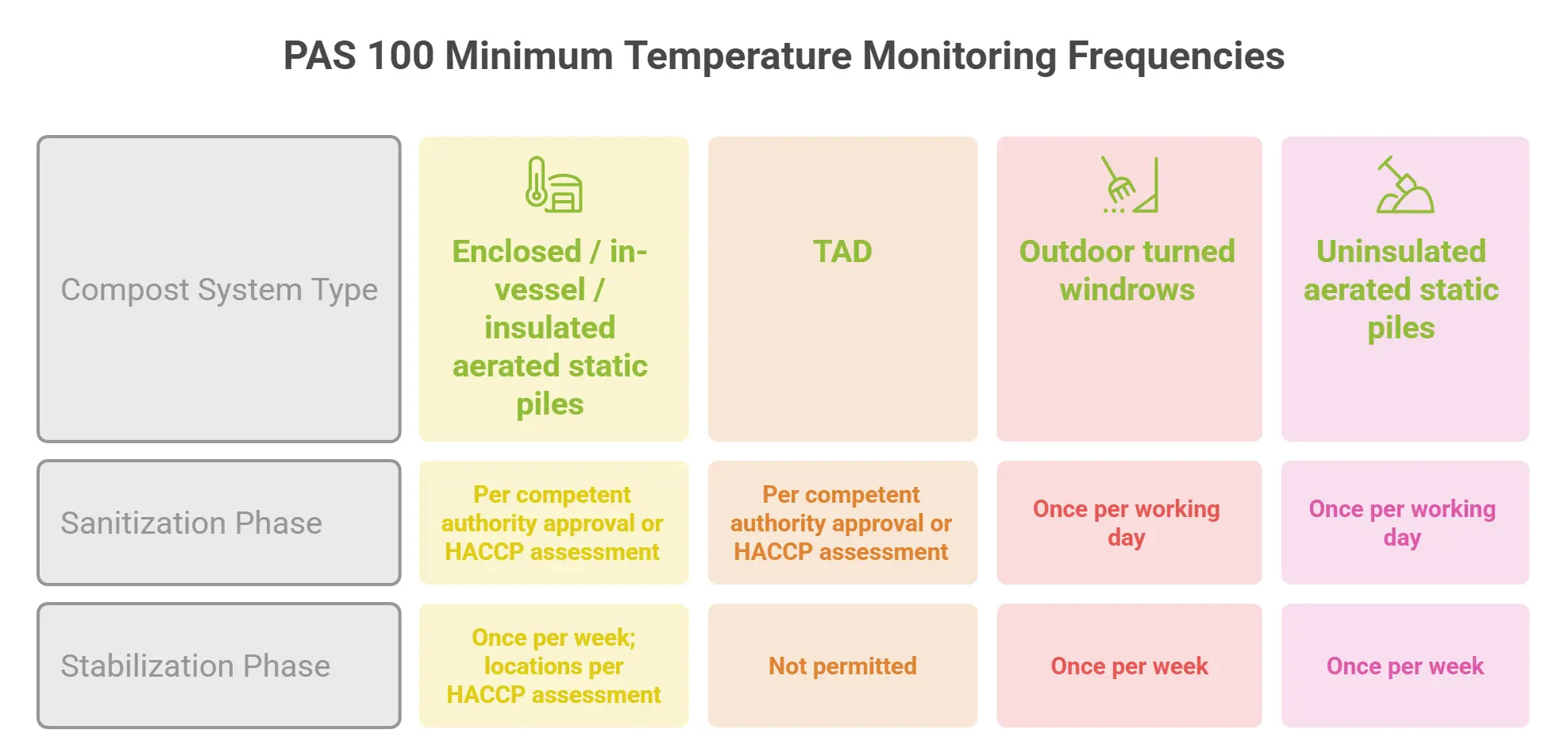
Enclosed / In-Vessel / Insulated Aerated Static Piles (Including Housed Windrows)
- Sanitization phase: Per competent authority approval (ABP inputs), or per your HACCP assessment (non-ABP)
- Stabilization phase: At least once per week; locations determined by your HACCP assessment
Thermophilic aerobic digestion (TAD)
- Sanitization phase: Per competent authority approval (ABP), or per your HACCP assessment (non-ABP)
- Stabilization phase: TAD cannot be used for stabilization
Operators should note this specific distinction. TAD is a valid sanitization method, but after sanitization, the material must undergo a separate composting stabilization phase. TAD alone does not deliver a stable compost product under PAS 100
Outdoor turned windrows
- Sanitization phase: Once per working day
- Stabilization phase: Once per week
Uninsulated aerated static piles
- Sanitization phase: Once per working day
- Stabilization phase: Once per week
Where Must Temperature Probes Be Placed?
Monitoring frequency is only half the story. Where you place your temperature probes matters just as much, and the rules differ between outdoor system types in a way that’s easy to mix up.
Outdoor turned windrows
- Batches under 750 m³: 3 probes in the core zone
- Batches 750 m³ or greater: 1 probe per 250 m³ in the core zone
- Surface and base zones: not required
Uninsulated aerated static piles
- Batches under 750 m³: 3 probes in each of the core, surface, and base zones
- Batches 750 m³ or greater: 1 probe per 250 m³ in each of core, surface, and base zones
- All three zones (surface, core, base) must be monitored
This distinction, core only for turned windrows versus all three zones for uninsulated aerated static piles, is one of the most common audit findings in the industry. If your system is an uninsulated aerated static pile and you’re only monitoring the core, you have a compliance gap.
Special Case: Aerated static piles that are turned
If an outdoor aerated static pile is turned two or more times during its sanitization phase, it must be monitored as if it were a turned windrow: core zone only, once per working day. If it’s turned three or more times during stabilization, the turned windrow regime applies to that phase too.
Moisture monitoring
Moisture is a critical limit at both the pathogen reduction phase and stabilization. Requirements by system type:
- Outdoor systems: Monitor at least once per working day during the pathogen reduction phase, and weekly during stabilization.
- Enclosed or in-vessel systems: Frequency is determined by your HACCP assessment.
Weather monitoring
Where outdoor sanitization or stabilization is involved, PAS 100 recommends regularly monitoring and recording:
- Wind speed and direction
- Precipitation
- Ambient temperature
These factors all influence batch temperature and moisture levels. When deviations occur, weather records provide critical supporting evidence for corrective action decisions.
How Do I Maintain Calibration Compliance?
Having the correct monitoring setup is not sufficient on its own. The Quality Management System (QMS) must document the routine calibration check frequency and procedure in writing.
Operators must adhere to the following calibration requirements:
- An independent third-party calibration check is recommended at least once per year.
- A certificate of calibration alone is not sufficient, the assessor must supply a full record of key data and evaluation each time.
- If any part of the monitoring system produces inaccurate data, corrective action is required immediately.
- The affected component must be re-checked immediately after repair or replacement.
- All calibration records, repair details, and outcomes must be retained as QMS records.
Calibration Compliance Checklist
- Written calibration procedure documented in QMS
- Independent third-party check completed within the past 12 months
- Full evaluation record retained (not just certificate)
- Corrective action log maintained for any inaccurate readings
- Post-repair re-check completed and recorded
Ready to Make Compliance Easier?
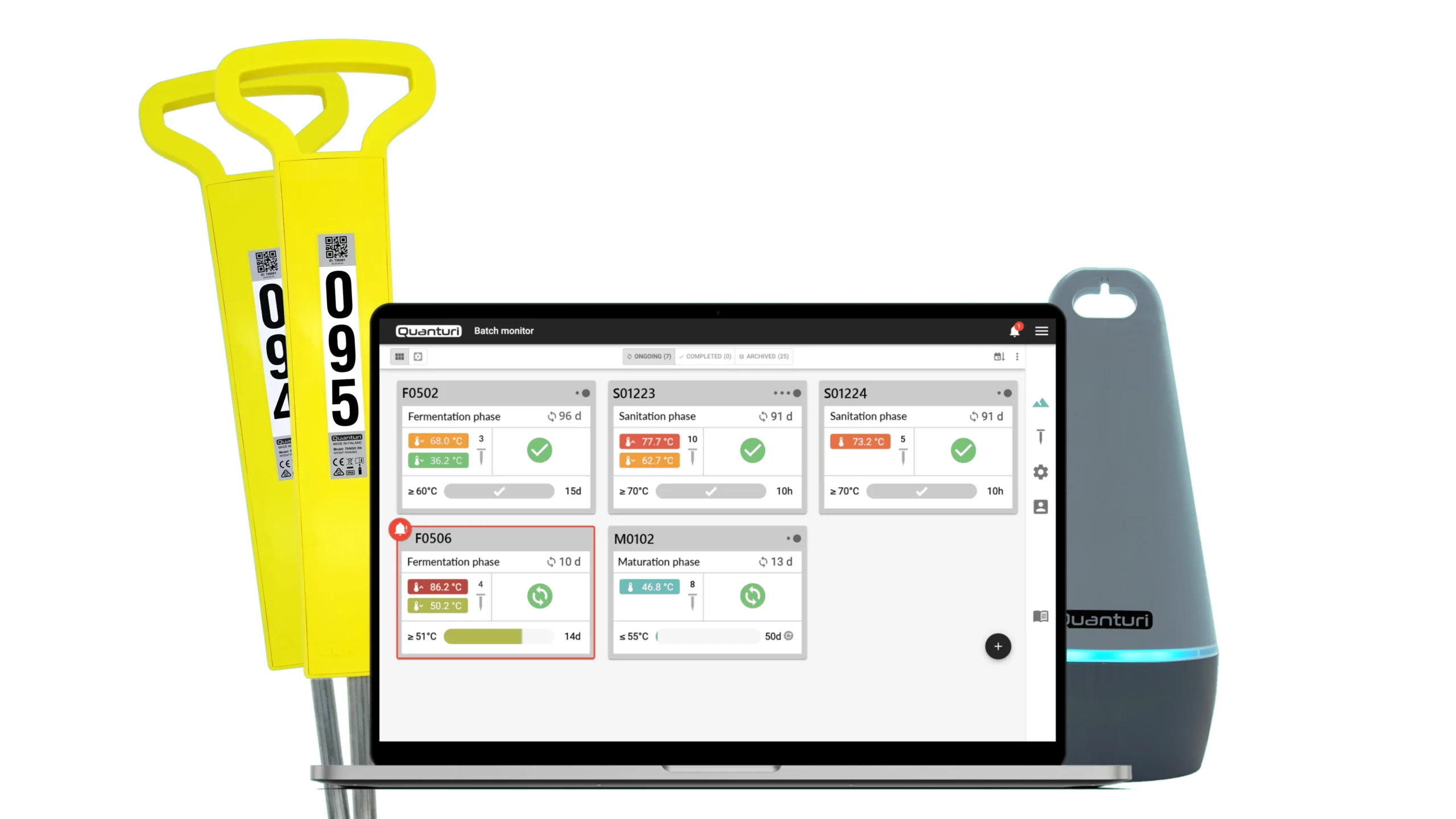
Tracking all of this manually across multiple batches, system types, and phases — is time-consuming and introduces risk of error. The Periskop System is built specifically for PAS 100 compost temperature monitoring.
Wireless temperature sensors (100 cm and 200 cm), a smart user-friendly software application, automatic batch tracking, continuous process data, pathogen eradication validation with temperature history and graphs, and one-click compliance reports delivering the traceability and accuracy needed to demonstrate PAS 100 compliance at audit.
References
- https://www.organics-recycling.org.uk/uploads/article3362/PAS%20100.pdf
- https://www.compostablematerials.org.uk/producers/standards
- https://www.qualitycompost.org.uk/documents/pas100